A practical guide to running visibility gear and safety tips for women who run early mornings or evenings – stay seen, safe, and confident in low light.
For many runners, early mornings or evenings after a long workday are the only realistic times to fit training into a busy schedule. With that often comes one shared condition: running in low light. It may feel intimidating at first, but it doesn’t have to be scary – it just comes with a few practical safety considerations.
Visibility gear helps you see and be seen, so you can move with confidence and focus on the run itself. The right gear, paired with a few simple habits, can make early morning and evening runs feel calmer, safer, and far more enjoyable.
In this guide, we’ll focus on what actually helps with running in low light – from visibility gear that works without hassle to small, realistic safety tips you can apply without turning every runs into a checklist.
Why visibility matters for early morning and evening runs
Running in low light doesn’t always mean full darkness. Early morning and late evenings often come with changing light conditions – glare from a low sun, long shadows, dawn or dusk, or uneven lighting on streets and paths. These transitions can make it harder for others to clearly see what’s ahead, even if you feel like visibility is “good enough” from your perspective.
Runners are generally harder to spot than cars or cyclists. We move slower, quieter, take up less space, and don’t come with built-in lights. From a sometimes sleepy or tired driver’s point of view, a runner can blend into the background surprisingly easily, especially in low light, busy traffic, or visually cluttered environments.
Being visible is simply reducing uncertainty. When you’re easy to see and move in a predictable pattern, others have more time to react, adjust, and give you space. That small shift makes running in low light feel calmer and more controlled, so you can focus on your pace, your breathing, and enjoy the run instead of constantly scanning for risk.
Running visibility gear that actually helps in low light
When it comes to running in low light, not all visibility gear is necessary – and not all is equally useful. The goal isn’t to glow like a Christmas tree, but to be easy to spot from different angles, without adding friction that makes you skip wearing it altogether.
Reflective gear: what actually works
Reflective details are better than nothing, but small logos or thin strips on dark clothing often don’t do much in real-world conditions. They usually only catch light at very specific angles and at close distance, which means they’re easy to miss.
Larger reflective surfaces are far more effective. Reflective panels, vests, or pattern on jackets or leggings create clearer contrast and are easier for drivers to register quickly.
Placement matters almost as much as size. Moving reflective elements, like straps around the ankles, calves, or arms, are especially effective because they final “human movement” to drivers. Static reflective logos on the chest or back don’t communicate that as clearly.
That’s why a dark outfit with a tiny reflective element often feels “safe enough”, but doesn’t actually offer much visibility in low light.
Lights and headlamps: see and be seen
Lights serve two different purposes: helping you see where you’re going, and helping others see you.
Headlamps are useful when you need to see uneven terrain or poorly lit paths, but they can create glare for oncoming traffic or other runners if they’re too bright or angled incorrectly.
Chest lights are particularly effective for visibility from a distance. They move naturally with your stride and are less likely to bounce or shift than headlamps.
Clip-on lights are a flexible option for adding visibility to the back or sides, especially when combined with reflective gear.
Early morning and evening runs come with slightly different challenges. In the morning, drivers may still be waking up and adjusting to low light. As for the evening, glare from headlights, streetlights, or wet roads can make smaller lights harder to notice. In both cases, a single dim light usually isn’t enough. Combining lights with reflective elements works best.
Visibility vests, belts, and straps
Visibility gear in the form of vests, belts, and straps are some of the most effective options for running in low light, especially if you’re regularly running before sunrise or after dark.
Their biggest advantage is combining coverage with movement. They create a clear, high-contrast outline of your upper body, making you easier to spot from multiple angles. Many also add built-in lights for added visibility.
The only downside may be comfort. If they’re bulky, awkward, or difficult to put on, you’re more likely to skip wearing them altogether, especially on short runs. Fit and ease of use matter a lot for building a habit. Lightweight designs with quick on/off fastenings are far more likely to become part of your routine.
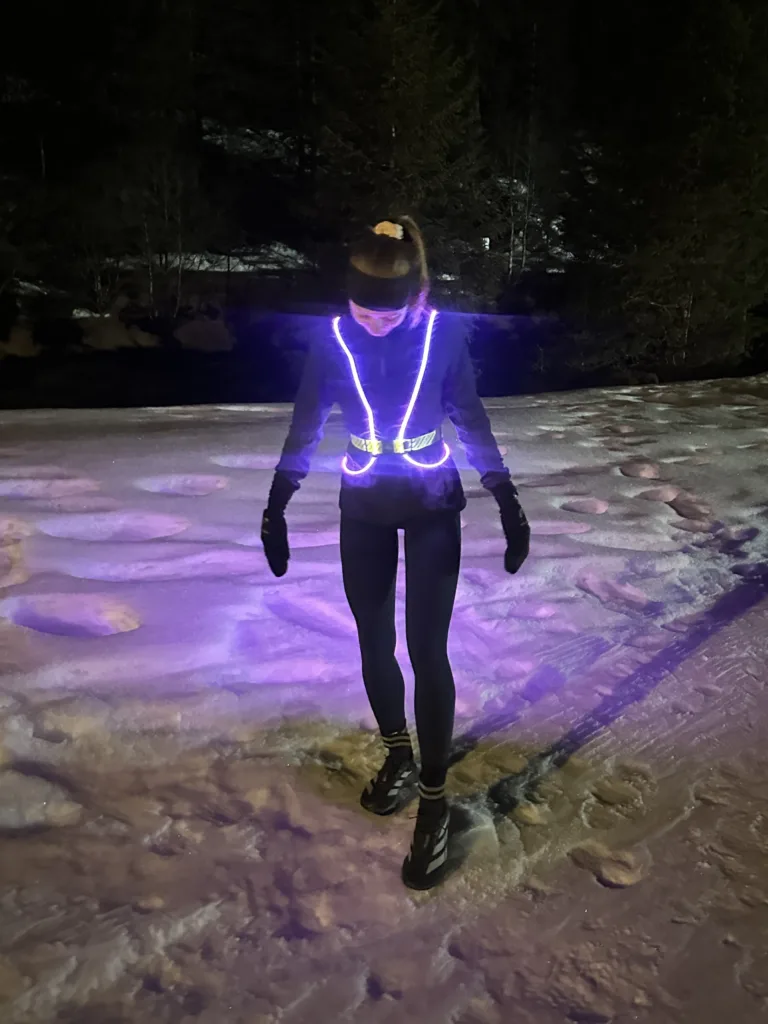
As for my setup, since the start of this winter I’ve been very happily using the Noxgear Tracer 2 vest on all of my morning and night runs. I combine it with ankle straps and reflective pattern on my shoes. If you’d like to read my thoughts on the Noxgear vest, here’s my full review.
If you find yourself hesitating to put something on, it probably won’t make it into your regular rotation. The best visibility gear is the kind that you’ll actually wear, even on chaotic, rushed mornings or tired evenings.
How to use visibility gear effectively
Brightness of your visibility gear isn’t the only factor – where and how you wear it matters more than how powerful it is on paper.
One of the biggest mistakes runners make is relying on a single bright element, often placed too low or too high, and assuming it’s enough. In reality, effective visibility comes from a combination of placement, movement, and coverage.
Placement over brightness
A very bright light placed poorly can be less effective than a moderate one placed well. Visibility works best when others can quickly understand what they’re seeing and how it’s moving.
Aim for both front and back visibility whenever possible. Being seen from only one direction leaves too much guesswork for drivers, cyclists, or other path users approaching from behind or the side.
Height and movement
Movement is one of the strongest visual signals. Lights or reflective elements placed on ankles, calves, or arms stand out more than static logos because the motion makes your movement predictable.
At the same time, having visibility at torso level helps define your position, especially from a distance. A combination of moving elements lower down and a steady light or reflective surface on your upper body tends to work best.
Head-level lights can be useful for seeing the path ahead, but they shouldn’t be your only visibility tool. They’re easy to angle incorrectly, and they don’t always make your body visible from afar.
Common visibility mistakes to avoid
Here are a few missteps that can reduce the effectiveness of even best visibility gear:
- Wearing lights too low, where they’re hidden by curbs, parked cars, or uneven terrain
- Letting reflective elements get blocked by layers, vests, or loose jackets
- Relying on just one light, especially if it’s dim or only visible from one angle
- Choosing gear that shifts, bounces, or needs constant adjusting mid-run
Ease of use
The best visibility setup is the one you’ll actually stick with. Gear that’s complicated to put on, uncomfortable, or annoying to manage quickly gets skipped, especially on rushed mornings or tired evenings.
Ease of use matters:
- quick on/off designs
- simple charging routines you can build into your week
- storage that makes gear easy to grab, not hunt for
If something needs constant remembering, fiddling, or charging at the last minute, it’s less likely to become part of your routine. Visibility works best when it’s a habit, not another chore.
Running safety tips beyond gear
Visibility gear plays an important role, but it’s only a part of staying safe during early morning and evening runs. Small, thoughtful choices around routes, awareness, and mindset can make a noticeable difference, often without any extra effort or equipment.
Route choice and timing
Try to stick to familiar routes whenever running in the dark. Knowing where crossings, uneven pavement, and poorly lit sections are helps you stay relaxed and anticipate what’s ahead instead of being caught off guard.
Try to avoid blind corners, tight paths, and crossings when you can, especially during low-light hours. Areas where drivers have limited visibility or are focused on turning rather than scanning the road increase uncertainty for everyone involved.
If you’re early morning runner, consider heading out slightly later, once there’s more ambient light or foot traffic, instead of running in pitch darkness. That doesn’t mean you need to always wait for perfect conditions, but sometimes small trade-offs are worth feeling calmer and safer on a given day.
Awareness and predictability
A helpful mindset for running in low light is to assume drivers haven’t seen you yet, even if you’re visible. This keeps you alert without making you anxious.
Make eye contact when crossing roads, use clear body language, and avoid sudden changes in direction. Predictable movement makes it easier for others to understand where you’re going and how they should react.
If you run with headphones, consider choosing a bone-conducting model, keeping the volume low, using transparency mode, or running with just one bud in, especially near traffic or busy paths. Being able to hear what’s happening around you is necessary for awareness – and confidence.
Trust and confidence without fear
Safety doesn’t mean running in constant tension. Staying calm, present, and aware helps you make better decisions than running on edge.
Simple habits can add peace of mind without overthinking. Letting someone close to you know your route and estimated return time, or using a tracking app, can make early morning or evening runs feel more relaxed, especially if you’re running alone.e
Confidence doesn’t mean ignoring risk, and caution doesn’t mean fear. Over time, as you learn which routes, timings, and setups work best for you, running in low light often starts to feel more familiar and controlled. The growing sense of ease is what allows you to focus on the run while staying aware and safe – and keep showing up consistently.
Be safe, be seen
Visibility works best treated as a habit, not a checklist. Your gear should be easy to reach for automatically when you’re heading out for an early morning or evening run – without extra thought or effort.
You don’t need the perfect setup or the brightest gear. One or two small, well-placed essentials, paired with intentional habits, can make a meaningful difference to your safety and confidence. Over time, those choices add up, making running feel calmer, more controlled, and easier to repeat.
If you’d like to dive deeper into running in challenging conditions, you might also find these posts helpful:
Running in low light shouldn’t feel scary or intimidating. With a setup that fits your routine, staying visible becomes second nature, and you can focus on what actually matters: moving your body, clearing your head, and enjoying your run.
