A gentle, realistic way to start running, even with a busy schedule.
If you’re starting from zero, feeling unfit, or struggling to imagine yourself as “a runner,” you’re not alone. Your running routine doesn’t have to be intense or overwhelming to be effective. You don’t need hours-long workouts, perfect conditions, or tons of free time. What you do need is a simple structure that feels doable in real life.
This 4-week beginner plan was designed for busy women who want to start running without pressure and burnout. You’ll train three times per week, using short, manageable run-walk intervals that build confidence step by step. Optional gentle-movement days support consistency without extra fatigue. The goal isn’t speed or distance, but forming a running habit you can actually stick to.
Benefits of the habit-building running plan
Many women quit running, because they try to do too much too soon. Increasing the mileage too quick and skipping rest days can lead to burnout, exhaustion, and even injuries.
This plan will give you a clear direction without overthinking. Here’s why it works.
Consistency over intensity
Short, regular sessions are easier to fit into a busy life, and far better for building endurance.
Run-walk intervals
You’ll alternate running and walking to keep your heart rate comfortable and avoid burnout.
Optional movement days
Light activity supports recovery, improves mobility, and helps build a daily movement habit.
Built-in flexibility
Shuffle workout days as needed – life happens! Just aim not to skip the three weekly runs.
Easy progression
Each week builds gently, giving you small wins that boost confidence and keep you motivated.
Read more: Common beginner running mistakes – and how to avoid them.
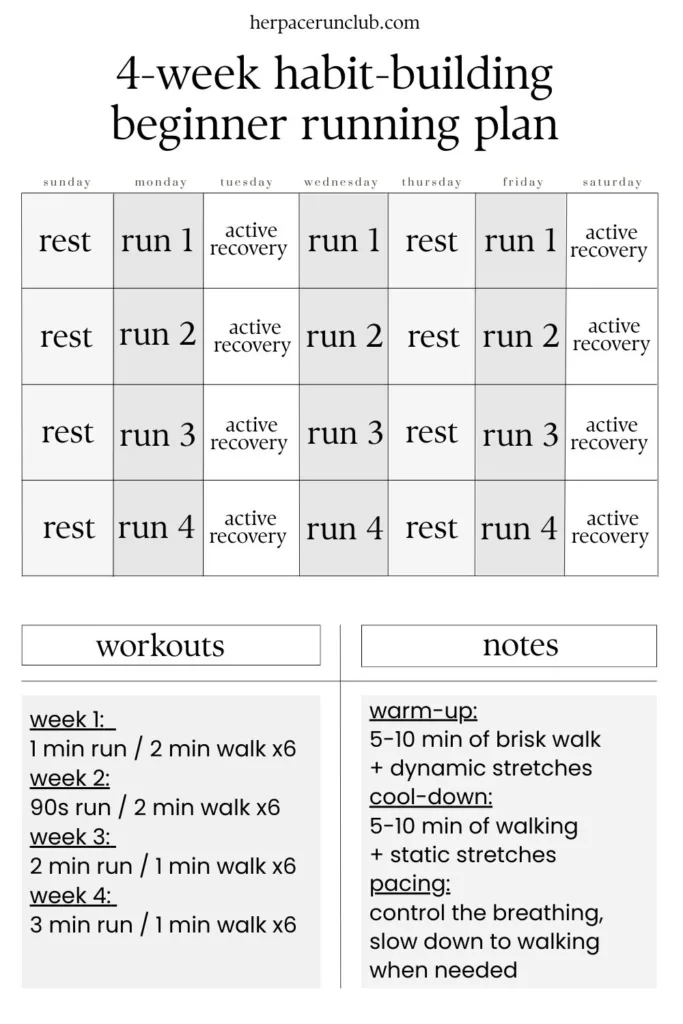
Weekly schedule
| Day | Activity |
| Monday | Run-walk workout |
| Tuesday | Active recovery (walk, yoga, swimming) |
| Wednesday | Run-walk workout |
| Thursday | Rest |
| Friday | Run-walk workout |
| Saturday | Active recovery (walk, yoga, swimming) |
| Sunday | Rest |
You can swap days around if needed, or skip active recovery, but don’t miss runs and rest days. They are essential to build your running habit successfully and safely.
Before you start, make sure your body is ready for a new fitness routine. Read Signs you’re ready to start running for a quick checklist.
The workouts
Every session has three parts:
Warm-up (5–10 minutes)
A brisk walk and a few dynamic moves (leg swings, ankle circles, hip circles) to ease into movement.
Run-walk intervals
Jog at a pace where you could speak in full sentences.
If you’re breathless, return to walking. It’s not a failure – it’s the plan working.
Cool-down (5 minutes)
Slow walking and gentle stretches.
Week 1
- Warm-up: 5 min brisk walk / dynamic stretches
- Run-walk: 1 min run / 2 min walk × 6 rounds
- Cool-down: 5 min easy walk
Week 2
- Warm-up: 5 min brisk walk / dynamic stretches
- Run-walk: 90 sec run / 2 min walk × 6 rounds
- Cool-down: 5 min walk
Week 3
- Warm-up: 5 min brisk walk / dynamic stretches
- Run-walk: 2 min run / 1 min walk × 6 rounds
- Cool-down: 5 min walk
Week 4
- Warm-up: 5 min brisk walk / dynamic stretches
- Run-walk: 3 min run / 1 min walk × 6 rounds
- Cool-down: 5 min walk
Tips to set yourself up for success
Morning vs evening
There’s no universal best time of day to run – both have their benefits and disadvantages. The ideal time to run is the one that fits your schedule seamlessly and allows you to stay consistent long-term.
Read more: How to become a morning runner as a busy woman.
Get the right gear
You don’t need to spend a fortune to start running. Focus on a few essentials first:
- Running shoes: The most important investment. Make sure they fit well and look for a supportive, cushioned sole. If possible, get a gait analysis at a local running store – or shop online if you already know your fit. (Read more: Beginner running shoes: a guide to the perfect first pair)
- Sports bra: A supportive sports bra is key for comfort, especially after an injury or postpartum.
- Clothing: There’s no need to buy all the gear at the beginning. Use what you already own – any breathable top, sweat-wicking leggings, or gym shorts that you’re comfortable moving in. Add new pieces only as needed.
- Optional: Running watches or fitness trackers are great tools, but not must-haves. You can easily track intervals with a phone timer or running app.
Slow down
Pace does not matter, especially at the beginning. You’re building endurance through time spent moving, not speed.
Read more: Common beginner running mistakes women make – and how to avoid them.
Stay flexible
Busy week? Swap days around or move your run from morning to evening. Just try not to skip the run entirely.
Read more: How to build a running habit that fits a busy schedule.
Listen to your body
Soreness is normal. Sharp pain is not. Rest when needed and adjust as you go.
Read more: Running recovery routine: small habits that fit busy schedules.
Celebrate small wins
Finished a full week? Ran continuously for a few minutes longer? Those moments matter – they build confidence.
Don’t compare yourself
Your pace, your progress, your journey. Slow is still forward.
The results
By the end of these four weeks, you’ll have something far more valuable than speed or mileage: a real running routine you can confidently repeat. Your endurance will improve naturally and gently, your body will start adapting to the impact, and you’ll feel more comfortable lacing up and getting out the door. Most importantly, you’ll begin seeing yourself as someone who can run – someone who shows up, even on busy days, and builds progress through consistency rather than pressure.
What you can do next:
- Repeat the 4-week plan to start running again until ready for longer runs.
- Stick with Week 4 workouts and gradually increase intervals or number of days.
- Transition to a structured 5K plan, like C25K, Nike Run Club training plan, or Runna’s 5K.
Whatever you choose as your next step, you’ll already have the foundation: the habit, the routine, and the confidence that makes the next steps feel realistic and achievable.
Running doesn’t have to be complicated. Good pair of running shoes, 30 minutes a day, and a little motivation are all you need to get started. And it really does get easier as it gets harder!
Read more: How to start running as a busy woman.
Join our community and get the full, printable schedule with the workouts and notes included – straight to your inbox:
